Guide · For agencies
White-label accessibility services for agencies: what to outsource and how to price it
How agencies add accessibility to their services without hiring a specialist team: which work to hand off, how to price it for profit, and how to choose a partner you can trust with your clients.
The short answer
A white-label accessibility partner does the specialist work, such as manual WCAG testing, PDF remediation, captions and Accessibility Conformance Reports (ACRs), and delivers it under your agency’s name. You keep the client, the scope and the price. Done well, it lets a small agency say yes to accessibility requests without hiring a team of screen-reader testers, and it turns a support headache into a profitable service line.
The model works when three things are true: you outsource the work that needs daily specialist skill, you keep the client-facing work, and you price every job in layers so your own time and margin are visible.
Why clients are asking now
Accessibility requests rarely arrive with the words “WCAG audit.” They arrive as a city clerk asking whether last year’s agenda PDFs are a problem, a hospital marketing team forwarding a letter from legal, or a SaaS client who needs an ACR for a bid. Behind most of them is one of five drivers:
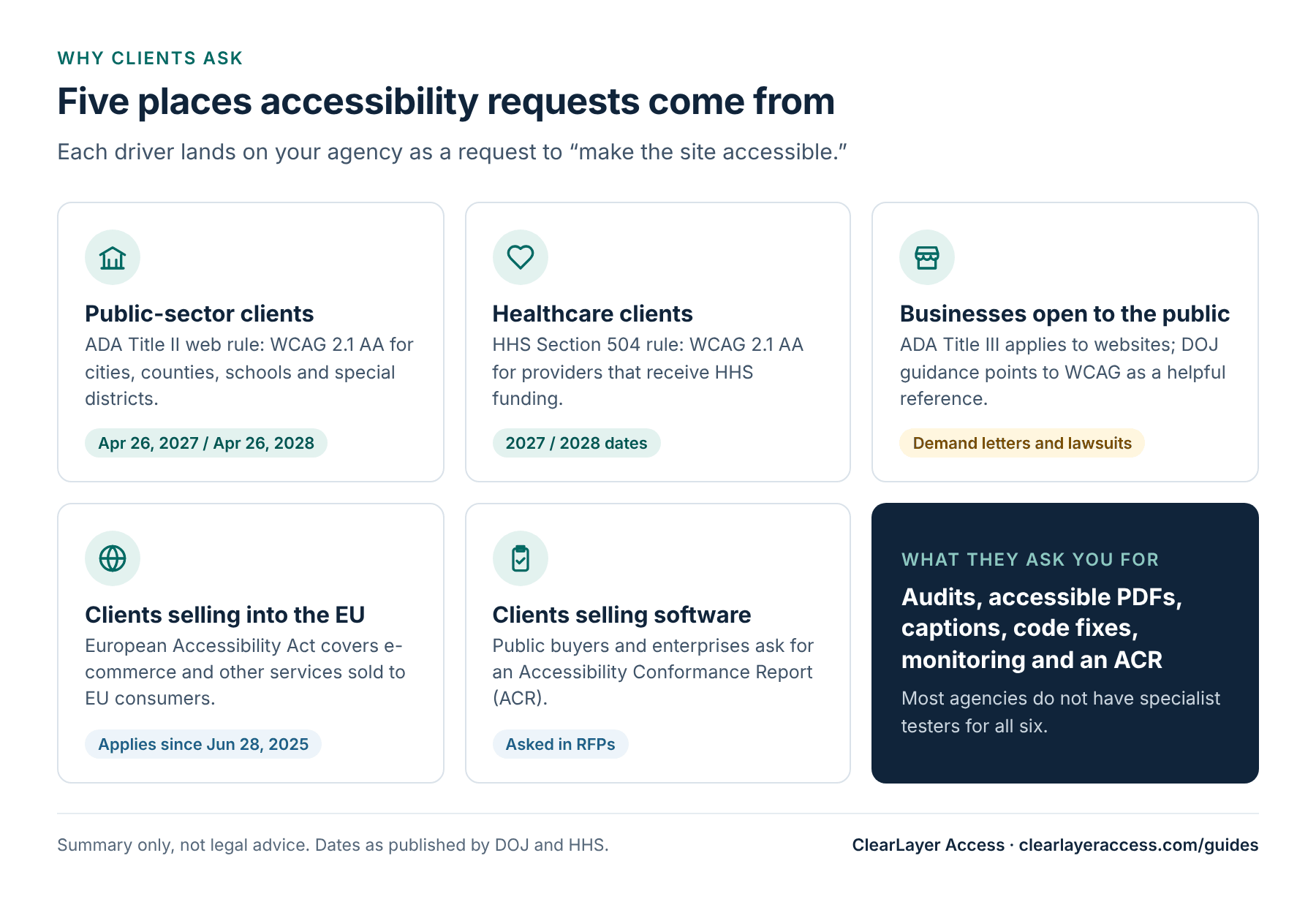
- Public-sector clients. The DOJ’s ADA Title II web rule requires state and local governments to meet WCAG 2.1 AA. An interim final rule published April 20, 2026 moved the dates to April 26, 2027 for entities with 50,000 or more people and April 26, 2028 for smaller entities and special districts. Their backlog is mostly PDFs; see ADA Title II PDF requirements.
- Healthcare clients. Providers that receive HHS funding face the HHS Section 504 web rule, which also uses WCAG 2.1 AA, with dates in 2027 and 2028.
- Businesses open to the public. The DOJ’s web accessibility guidance says ADA Title III covers the websites of businesses open to the public. There is no separate technical rule for them, so demand letters usually measure sites against WCAG.
- Clients selling into the EU. The European Accessibility Act has applied since June 28, 2025 to many products and services sold to EU consumers, including e-commerce.
- Clients selling software. Public buyers and large companies ask for an ACR, usually written on the ITI VPAT® template. See VPAT and ACR, explained.
What white-label means (and what it does not)
In a white-label arrangement the partner works one step behind you. Reports, remediated files and test notes carry your agency’s branding and your client’s details. The partner talks to your team, not to your client, unless you ask it to.
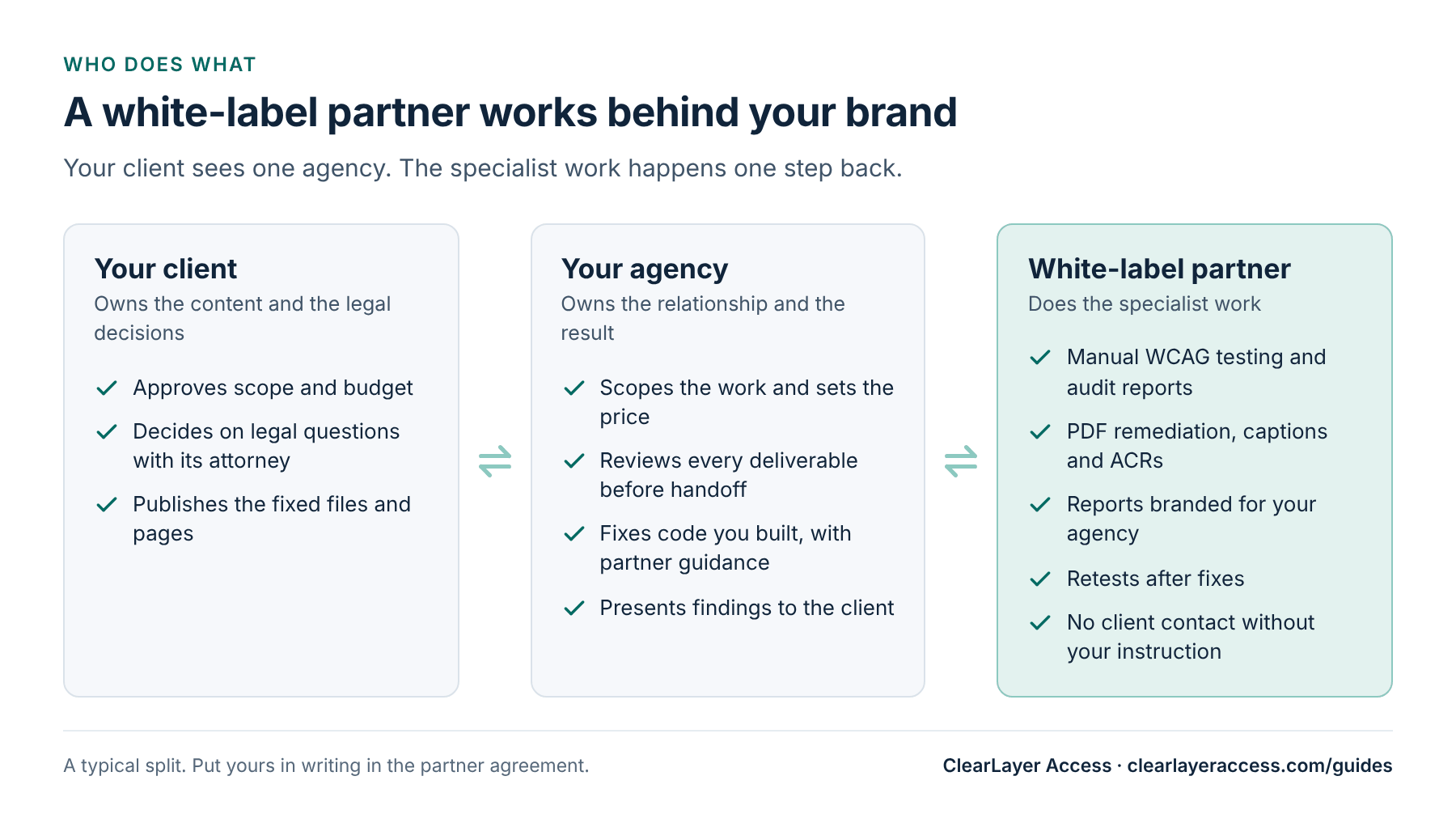
White-label does not mean hands-off. You still review every deliverable before it reaches the client, because your name is on it. It also does not move legal responsibility: the client decides how its obligations apply, with its attorney, and nobody in the chain should promise “compliance.”
What to outsource and what to keep
The test is simple. If a task needs someone who works with screen readers, tagging tools or caption files every day, outsource it. If a task depends on knowing the client, the codebase or the project history, keep it.
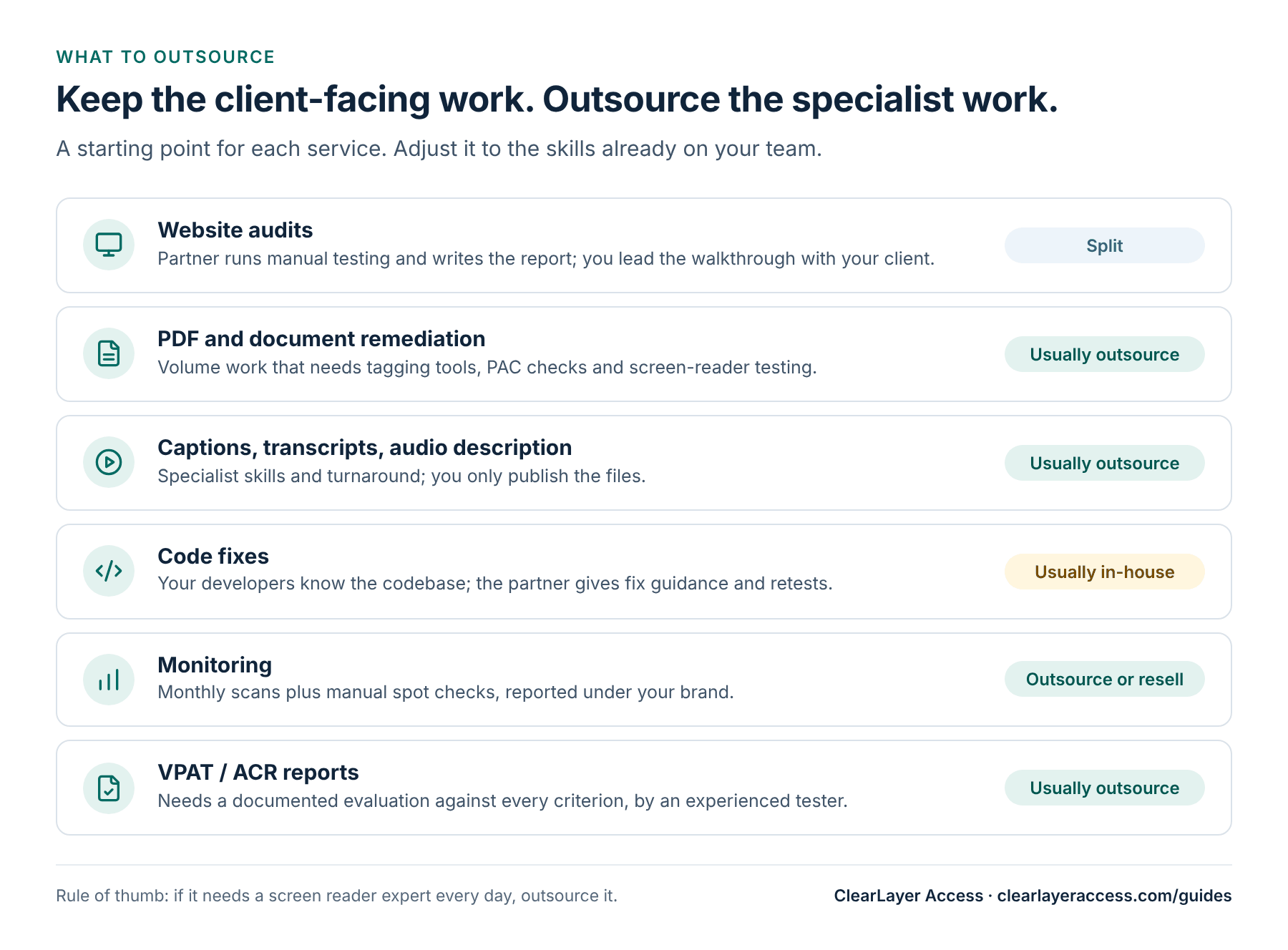
- Website audits. Automated scanners catch only part of the problems; W3C’s guide to selecting evaluation tools notes that many checks need human judgment. Let the partner run the manual keyboard and screen-reader testing, and you run the findings meeting.
- PDF remediation. This is the most common outsourced task, especially for public-sector clients with years of agendas, minutes and forms. Volume is unpredictable, and a partner can absorb spikes.
- Captions and audio description. Specialist work with its own file formats and quality rules. Outsource it and publish the files.
- Code fixes. Your developers know the build, so they should usually make the changes. Ask the partner for issue-by-issue fix guidance and a retest, or outsource fixes only on projects you did not build.
- Monitoring. A monthly scan plus manual spot checks, reported under your brand, turns one-off projects into recurring revenue.
- VPAT / ACR reports. An ACR needs a documented evaluation against every applicable criterion. Outsourcing to an experienced tester protects your client in procurement reviews.
How to price it
Price outsourced accessibility work in three layers: the partner’s cost, your own time, and your margin. Agencies lose money when they forward the partner’s quote with a small markup and forget the hours they spend briefing, reviewing and presenting.
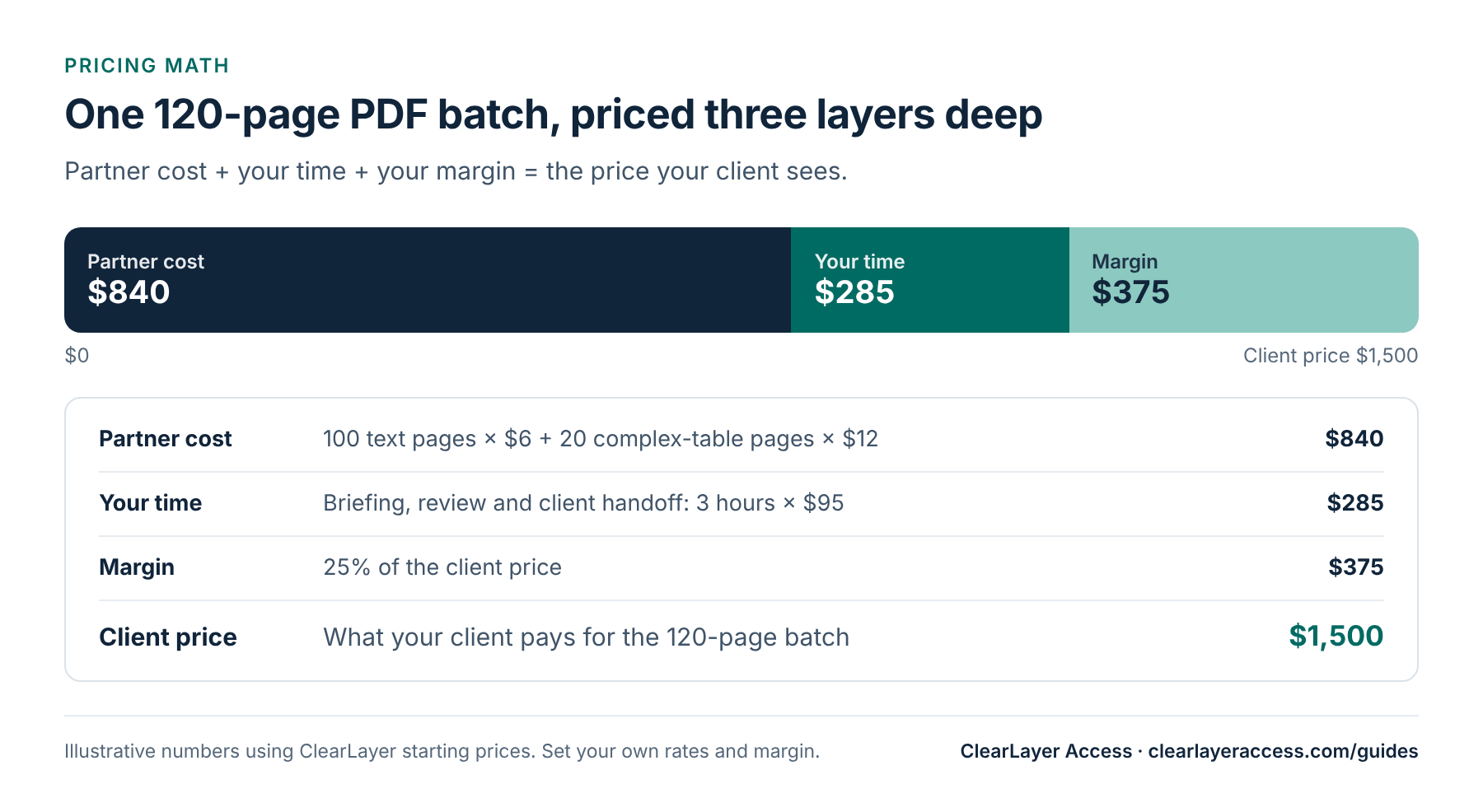
The example uses our published starting prices: document remediation from $6 per page and $12 per page for complex tables. The same method works for every service:
| Model | Best for | How to set the price |
|---|---|---|
| Cost-plus | PDF batches, captions, one-off audits | Partner cost + your hours + a margin you choose, quoted per project |
| Bundled | New builds and redesigns | An accessibility line inside the build quote: audit before launch, fixes, retest |
| Retainer | Monitoring, ongoing document flow | A monthly fee covering monitoring plus an agreed number of pages or fixes |
For reference, our other starting prices are website audits from $1,250 (up to 8 page templates), captions from $1.50 per minute, code fixes from $40 per issue, monitoring at $149 per month and ACRs from $950 per product. Final prices come in a written quote after we see the files or the site.
Scoping questions that protect your margin
Most margin is lost at scoping, not delivery. Before you quote, ask your client, or ask your partner to ask through you:
- Which standard and version? WCAG 2.1 AA for Title II and Section 504 work; WCAG 2.2 AA is the current W3C recommendation for everything else.
- How many pages, templates or minutes? Audits are priced by templates, PDFs by pages, media by minutes.
- What kind of content? Tables, fillable forms and scanned pages take more work than plain text. See what drives PDF remediation cost and scanned PDFs.
- Are the source files available? A Word original is often faster to fix than the PDF made from it.
- What is the deadline? Rush work costs more, so agree dates in writing.
- Is a retest included? Decide who fixes, who retests and how many rounds the price covers.
How to vet a white-label partner
Your partner’s mistakes reach your client under your logo, so vet the partner the way your client will vet you.
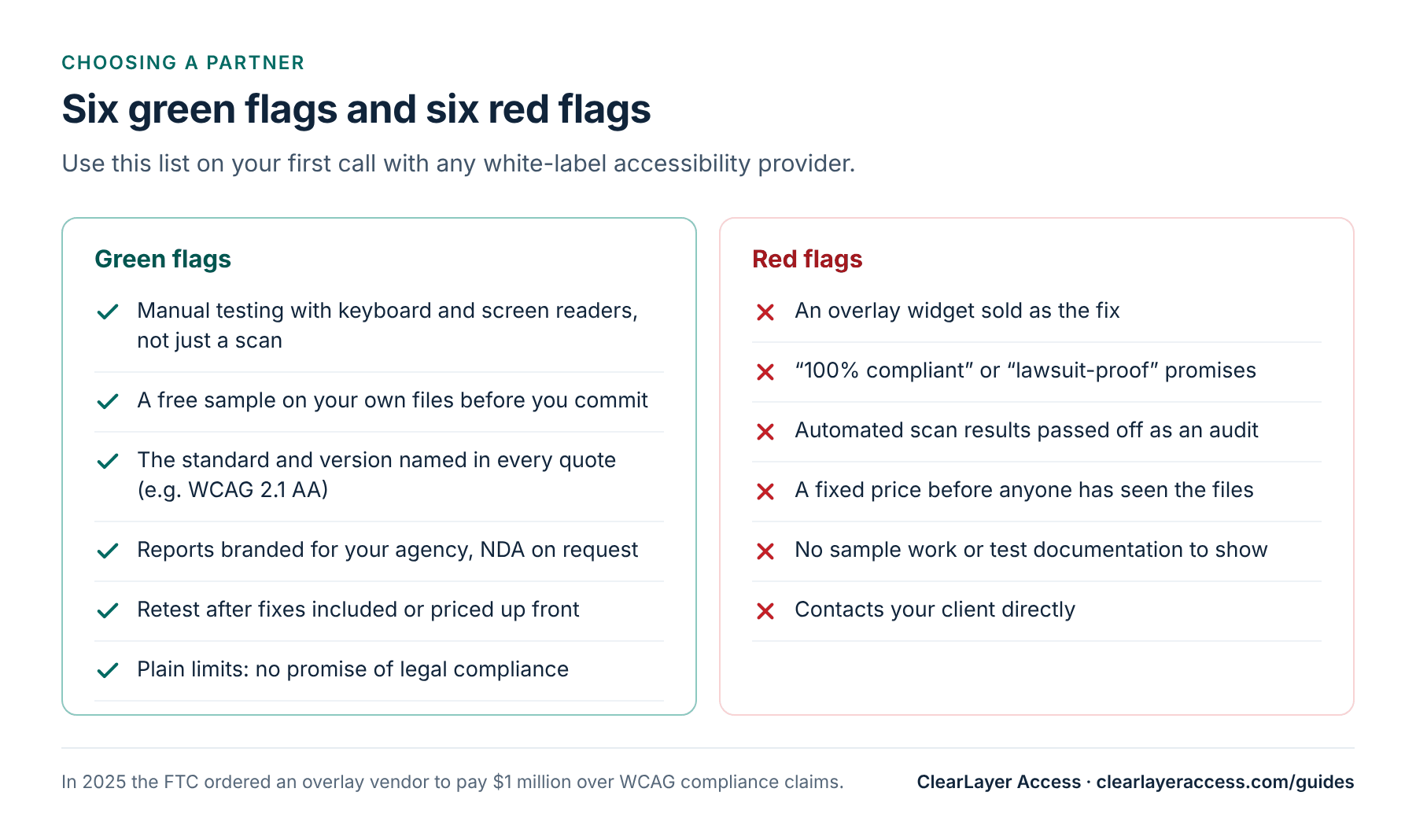
Be most careful with overlay widgets. In April 2025 the FTC ordered an overlay vendor to pay $1 million and barred it from claiming its automated product could make any website WCAG-compliant. A script on top of a site is not a substitute for fixing the site.
The best test is a sample on real files. Send a few difficult pages, not your easiest ones, and check the result yourself with a free checker such as PAC and the free NVDA screen reader. Then compare the report with our sample work to see what a complete deliverable looks like.
What to put in the partner agreement
- Scope and standard: services, page or template counts, and the WCAG version tested against.
- Branding and contact: deliverables under your brand, and no client contact without your written instruction.
- Confidentiality: an NDA, who can access files, and how long files are kept.
- Deadlines and rush terms: standard turnaround, express options and what happens if a date slips.
- Retests and corrections: how many rounds are included and how fast corrections come back.
- Limits: testing and remediation against a named standard, with no promise of legal compliance or legal outcomes.
Our agency program is built around these points: agency-branded reports, defined scope, NDA on request and no direct client contact.
Running your first project
Start small, with a job that has a clear edge, such as one batch of PDFs for a public-sector client or a pre-launch audit of a site you are already building. Then follow the same five steps every time:
- Brief. Send the files or URLs, the standard and version, the deadline and the branding you want on the report.
- Confirm scope. Get a written quote and delivery date back before any work starts, and price your own layer on top.
- Review. Open a few remediated pages in PAC, listen to one page and one table in NVDA, and read the report as your client will.
- Hand off. Give the client a one-page summary: what was tested, against which standard, what was fixed and what still needs attention.
- Keep it going. Offer monitoring or a document retainer, so new content does not undo the work.
Most clients publish new PDFs and pages every week, so the second project usually follows the first. That is where the recurring revenue comes from.
Prepared by ClearLayer Access. Published November 1, 2026; rules and references checked against official sources on November 1, 2026. This guide is general information, not legal advice, and following it does not guarantee compliance or any legal outcome.
Frequently asked questions
Subcontracting specialist work is common in agency work, but your client contract decides what you must disclose. Check its subcontracting, confidentiality and data-handling clauses, and make sure your partner agreement matches them.
Quote the version the client’s obligation names. The ADA Title II and HHS Section 504 rules use WCAG 2.1 AA. For other clients, WCAG 2.2 AA is the current W3C recommendation and includes all of 2.1, so testing to 2.2 AA also covers 2.1 AA.
Neither an agency nor a remediation partner can promise a legal outcome. Your contracts should describe the work as testing and remediation against a named standard, not a compliance guarantee, and your client should take legal questions to its own attorney.
Yes. Most agencies start with PDF remediation or a single audit, because both have a clear scope and a clear deliverable. Add monitoring or ACRs once the workflow with your partner is running smoothly.
Price rush delivery as a separate line. If your partner charges a premium for express or overnight work, pass it through with your own margin on top, and agree the deadline in writing before work starts.
Test a white-label partner on your own files.
Send up to 10 PDF pages from a real client project. We return the remediated files and a short test report you can review before you put your name on our work.
Up to 10 PDF pages for eligible organizations.