Guide · Procurement
What is a VPAT / ACR and how do you get one?
A buyer has asked for your VPAT. Here is what they actually need, which edition to choose, and how an ACR is produced.
VPAT and ACR: the difference
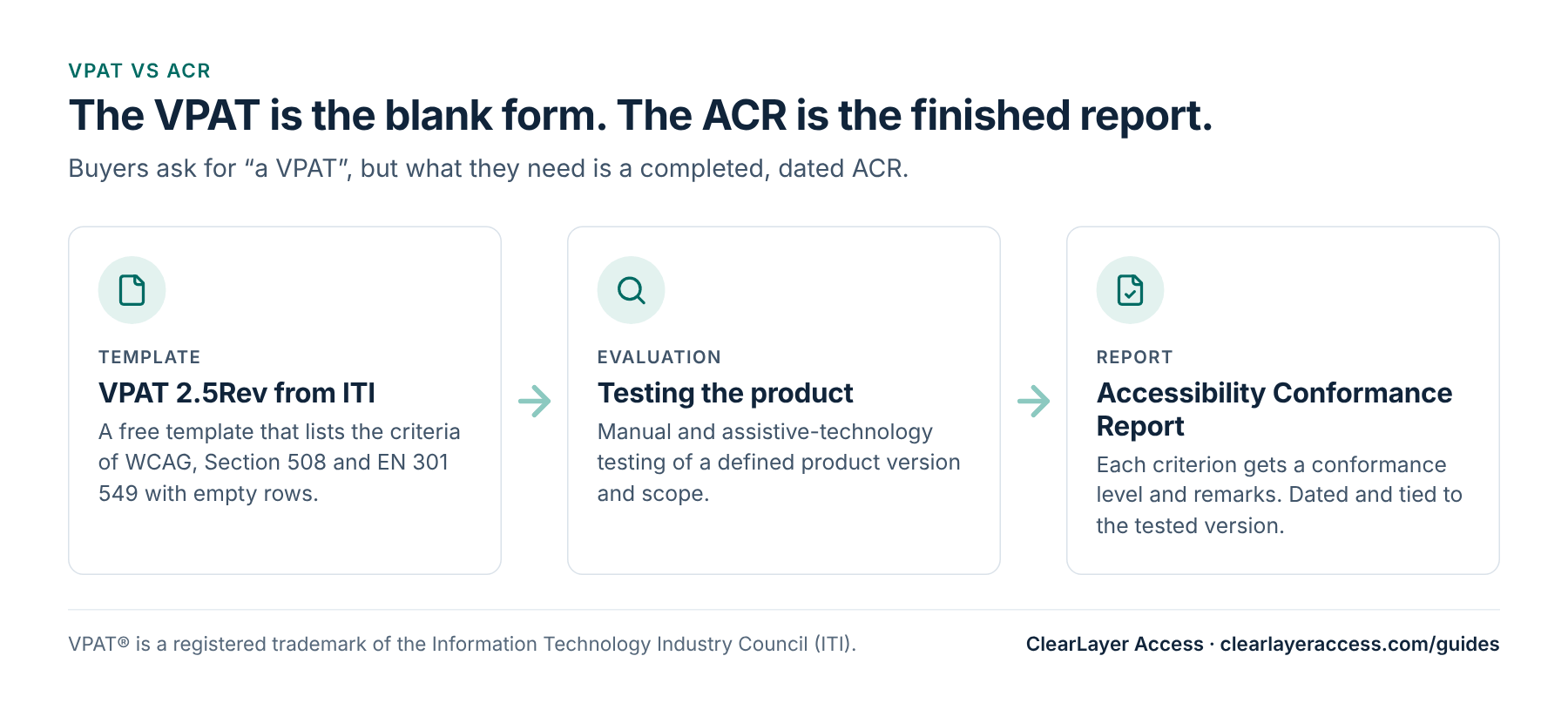
The Voluntary Product Accessibility Template (VPAT®) is a free template published by the Information Technology Industry Council (ITI). It lists the criteria of the main accessibility standards and leaves space to record how well a product supports each one.
An Accessibility Conformance Report (ACR) is the completed template: the VPAT filled in with the results of evaluating a specific product version. When a buyer asks for “your VPAT”, they almost always mean a current ACR.
Which edition to use
The current template is VPAT 2.5Rev, released by ITI in April 2025, in four editions:
- WCAG edition: reports against the Web Content Accessibility Guidelines, with criteria from WCAG 2.0, 2.1 and 2.2. A common choice for web products and for US state and local buyers.
- Section 508 edition: based on the Revised Section 508 Standards used in US federal procurement, which incorporate WCAG 2.0 Level A and AA. It also covers software, documentation and support services.
- EU edition: based on EN 301 549, the standard used in European public procurement, which incorporates WCAG 2.1.
- International (INT) edition: combines WCAG, Section 508 and EN 301 549 in one report, useful if you sell into several markets.
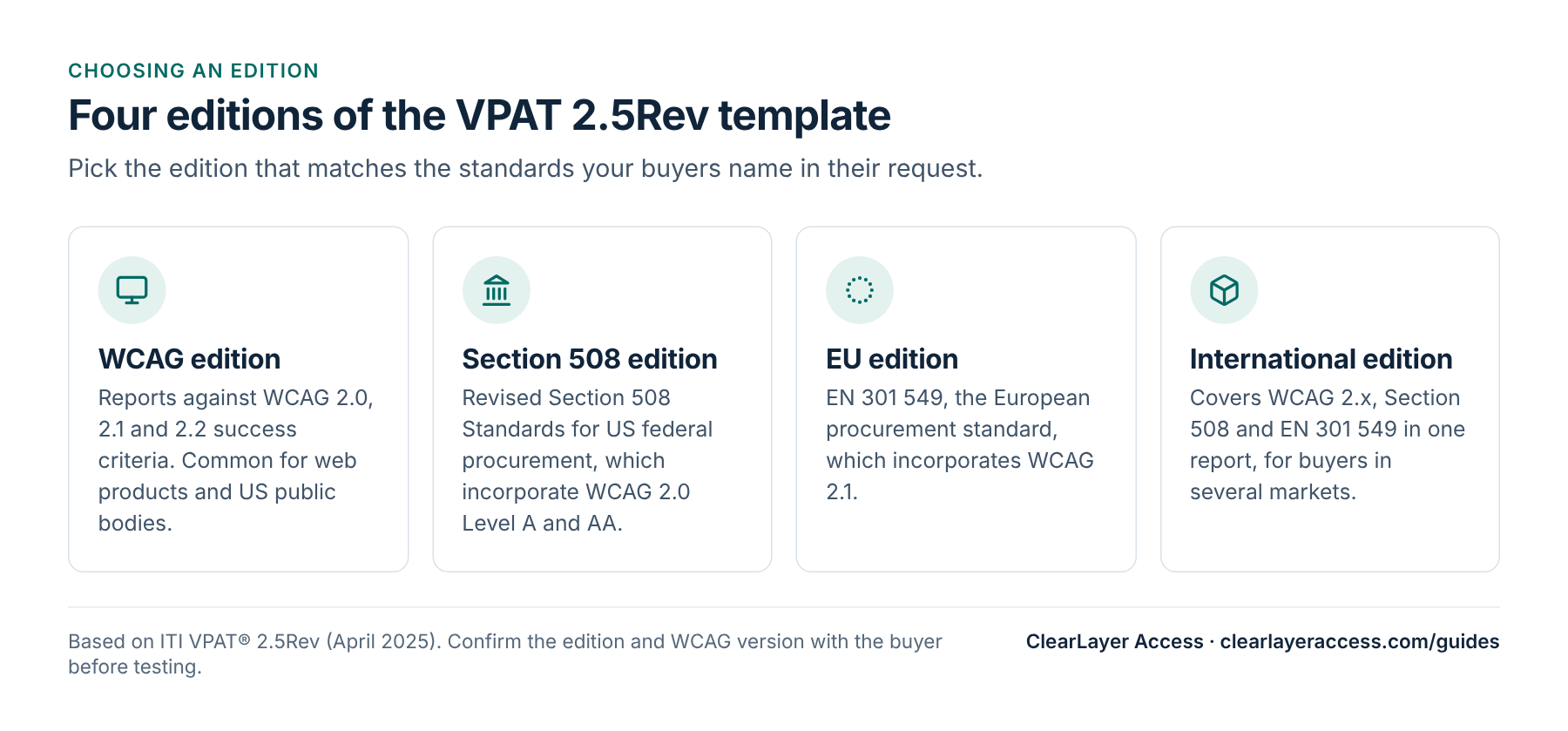
The edition and the WCAG version are separate choices: the edition decides which standards and sections the report covers, while the WCAG version (2.0, 2.1 or 2.2) and level (A and AA) decide which success criteria are evaluated. If the request does not say which edition or WCAG version it expects, ask before testing starts. Changing editions afterwards means redoing much of the report.
Who asks for one
ACRs are a standard part of buying technology in the public sector and in larger organizations. Typical requesters are:
- US federal agencies, which must consider Section 508 when they buy information and communication technology. Section 508 applies to federal agencies; the ADA Title II web rule applies to state and local governments. They are separate legal frameworks, even though both point to WCAG.
- State and local government agencies, increasingly so as the ADA Title II web rule deadlines approach.
- Public universities and colleges, whose procurement and IT accessibility teams often require an ACR before a purchase is approved.
- Large companies and European public bodies that write accessibility into their supplier requirements.
Procurement teams use the ACR to compare products and to plan workarounds for known gaps. It is often requested alongside security questionnaires during vendor review.
What is inside an ACR
A complete ACR names the product and version, the date of the report, the evaluation methods used and the standards covered. Its core is a set of tables. For every criterion it gives a conformance level and remarks:
- Supports: the functionality meets the criterion without known defects.
- Partially Supports: some functionality does not meet the criterion.
- Does Not Support: the majority of functionality does not meet it.
- Not Applicable: the criterion is not relevant to the product.
- Not Evaluated: allowed only for WCAG Level AAA criteria.
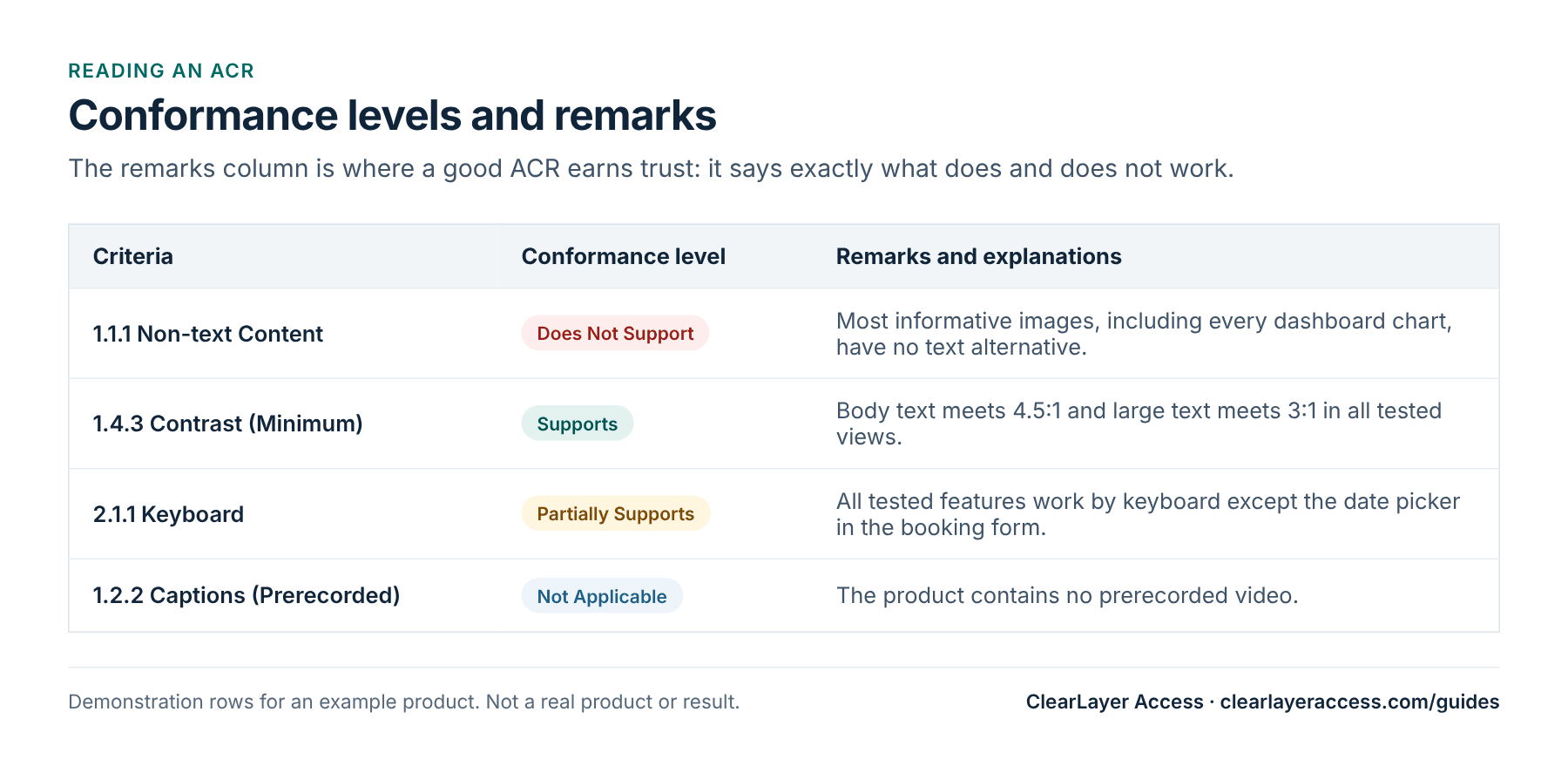
Experienced buyers read the remarks closely. An honest “Partially Supports” with a clear explanation builds more trust than a report that marks everything “Supports”.
How to get one
You can complete an ACR yourself or have an independent party evaluate the product. Either way the steps are similar:
- Define the scope: product, version, platforms, key user journeys, documentation and the edition required.
- Evaluate: manual testing with a keyboard and screen readers such as NVDA, supported by automated scanning, and checks of PDFs or help documents in scope.
- Draft the report: record a conformance level and a plain-language remark for each criterion.
- Review and deliver: you check the draft for accuracy, then the final ACR is dated and issued.
To speed things up, prepare test accounts with realistic data, a list of the main tasks users perform, and access to the version you will actually sell.
Common ACR mistakes
Procurement and accessibility teams review many ACRs, and the same problems come up again and again:
- Everything marked “Supports” with no remarks. Reviewers rarely believe it, and a quick keyboard test can disprove it.
- No evaluation methods. If the report does not say how the product was tested, readers cannot judge it.
- The wrong edition or WCAG version for the request, for example a Section 508 report for a buyer who asked for WCAG 2.1 AA.
- An out-of-date version: a report for a release from several years ago, describing screens that no longer exist.
- Copied content from another product or an older report, with remarks that do not match the product.
Using the ACR after delivery
Once you have a current ACR, make it easy to find. Many vendors post it on an accessibility or trust page, or share it through their sales team on request. Treat the gaps in the remarks as a roadmap: fix the issues that affect key tasks first, then re-test and update the report. Keeping a dated history of reports shows buyers that accessibility improves from release to release, which often matters as much as the current result.
If a buyer raises questions about a specific remark, answer with the facts from the evaluation and, where a fix is planned, a realistic date.
What an ACR is not
An ACR is not a certification and not a legal opinion. ITI does not review, approve or certify VPATs, and there is no pass or fail rating. An ACR records the evaluated support of one tested version on one date. When you ship a major release, update the report.
ClearLayer Access ACRs
We prepare ACRs on the ITI VPAT® 2.5Rev template in the WCAG, Section 508, EU or International edition, against WCAG 2.1 or 2.2 as required. Prices start from $950 per product, with the exact price confirmed in a written quote after scoping. ACRs are not offered on Express or Overnight timelines. If the evaluation turns up issues, our audit and code fix services can help you close them before the report is issued.
Prepared by ClearLayer Access. Published October 31, 2026; dates, rules and references checked against official sources on October 31, 2026. This guide is general information, not legal advice, and following it does not guarantee compliance or any legal outcome.
Frequently asked questions
Yes. ITI offers the VPAT template free of charge, and you do not need to be an ITI member to use it.
Either the product owner or an independent evaluator. Many buyers give more weight to reports based on documented, independent testing, but the template does not require it.
An ACR has no formal expiry date, but it describes one product version on one date. Buyers usually expect a report that matches the version they are buying, so update it after major releases.
No. ITI does not certify products, and an ACR is neither a certification nor a legal opinion. It documents the evaluated support of a tested version.
Get a VPAT / ACR for your product.
Share your product details and we will confirm the edition, scope, timeline and cost.
From $950/product